
Clean Agent Trace Tube Fire Suppression System
System Overview
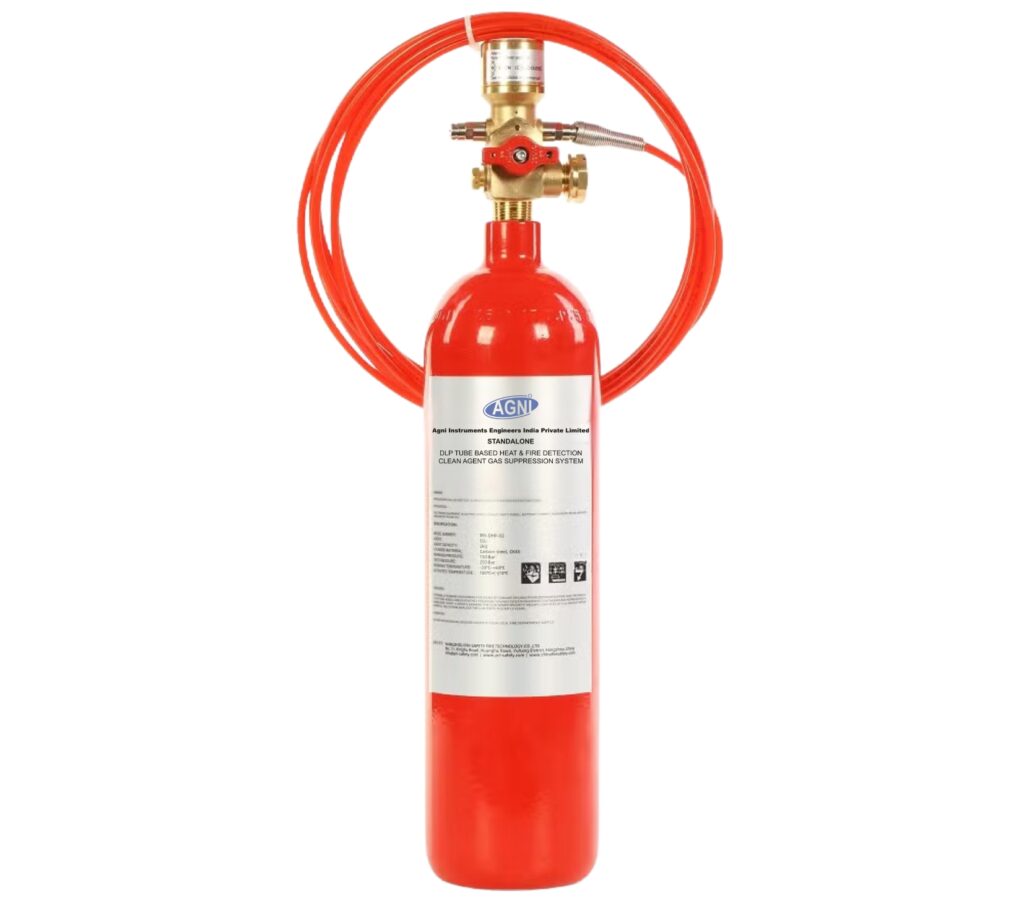
The Clean Agent Trace Tube Fire Suppression System is an automatic, localized fire detection and suppression solution designed for protecting enclosed or critical equipment areas such as electrical panels, server racks, CNC machines, battery cabinets, and control enclosures.
This system uses heat-sensitive polymer detection tubing that both detects and suppresses fires directly at the source, providing fast, reliable, and targeted protection without causing damage to equipment or leaving residue.
Operating Principle
The system operates on a self-activating principle, eliminating the need for external power or electronics.
A pressurized clean agent cylinder is connected to a specialized polymer trace tube routed throughout the protected enclosure.
When a fire occurs:
- The ambient temperature near the flame rises rapidly.
- The trace detection tube softens and ruptures at the hottest point (typically between 100–180°C).
- The sudden pressure drop triggers the release of the clean agent directly through the rupture point or through a "melting diffuse pipe" (depending on system type).
- The agent extinguishes the fire almost instantly — before it can spread or cause significant damage.
System Types
The system generally comes in two configurations:
Direct Release System
- The trace detection tube itself acts as both the detection and discharge line.
- When the tube ruptures, the extinguishing agent is released directly through the rupture onto the fire.
- Best suited for small enclosures or single-point risk areas.
Indirect Release System
- The trace detection tube serves only as a detection line.
- Upon rupture, pressure is vented, activating a separate valve that releases the agent through dedicated "melting diffuse pipe".
- Ideal for larger enclosures or where more controlled discharge distribution is required.
Suppression Agent
The system typically uses Clean Agents that are electrically non-conductive, residue-free, and safe for sensitive electronics. Common agents include:
- FK-5-1-12 (Novec™ 1230 or equivalent)
- HFC-227ea (FM-200® or equivalent)
- CO₂ (for non-occupied enclosures)
Agent Properties:
- Zero ozone depletion potential (ODP = 0).
- Low global warming potential (GWP).
- \Safe for use in normally occupied areas (for FK-5-1-12 / HFC-227ea).
System Components
| Component |
Description |
|
|---|---|---|
|
Cylinder Assembly |
High-pressure storage cylinder containing clean agent; available in various capacities (e.g., 2kg–10kg). |
|
|
Pressure Gauge with Switch |
Continuously monitors system pressure and provides electrical signal for supervisory panels. |
|
|
Flexible Detection Tube |
Heat-sensitive polymer tube (rated up to 25 bar); routed throughout the protected enclosure to detect heat or flames. |
|
|
Discharge Tube |
Precisely engineered tamprechar detection tube ensure even agent dispersion throughout the risk area. |
|
|
Mounting Bracket / Clamps |
Secure the cylinder and tubing inside or near the protected equipment. |
|
|
Actuation Head / Valve Assembly |
Automatic or manual valve for agent release; can include pressure switch feedback. |
|
|
Optional Control Panel Interface |
For alarm signaling, system monitoring, and integration with building fire alarm system. |
|
Advantages
- Automatic and self-contained — no external power required.
- Fast response — extinguishes fire at the source in seconds.
- Localized protection — minimizes agent quantity and cost.
- No residue or cleanup — safe for electronics and delicate components.
- Environmentally friendly — compliant with latest clean agent standards.
- Low maintenance — only periodic inspection required.
Compact design fits within or near electrical cabinets or small enclosures.
Applications
- Electrical & control panels
- Data racks and network enclosures
- Battery storage systems (ESS/BESS)
- CNC and manufacturing machinery
- Telecommunication cabinets
- ATM and kiosk enclosures
- Laboratory equipment and fume hoods
Standards and Compliance
The system design and components typically comply with:
UL 2166 / UL 2127
Clean Agent Extinguishing Systems
NFPA 2001
Standard on Clean Agent Fire Extinguishing Systems
IOS 14520
Gaseous Fire Extinguishing Systems
EN 15004
Fixed Firefighting Systems using Gaseous Agents
CE & LPCB
Certified Components (where applicable)